

Election Day is just over a week away, making this a good time to check in on the money race in this year’s elections.
The filing deadline for third-quarter campaign finance reports is tomorrow, and it will likely take several more days for those reports to become publicly available. In the meantime, I thought it would be interesting to take a look at North Carolina’s General Assembly races to see where the various campaigns stand financially.
One important caveat: The data below is current through June 30, so it provides a snapshot of where each campaign stood heading into the final months of the election. I plan to update this analysis once the third-quarter reports, which cover activity through October 17, become available.
If you want to jump straight into the numbers, you can explore them in the Carolina Money Trail app.
Republicans Hold a Significant Fundraising Advantage
The first thing I did was total the money raised and spent by general-election candidates in each General Assembly race over the full 2025–2026 election cycle, then group those totals by party.
The results show a substantial Republican fundraising advantage in both the state House and Senate. In each chamber, Republican candidates have raised roughly twice as much as their Democratic counterparts.
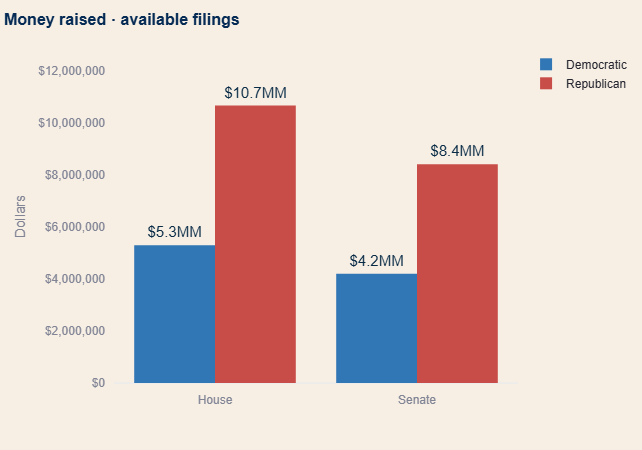
Fundraising among House Republicans has also been stronger than among Senate Republicans, although that is partly to be expected given the larger number of House seats.
Combining both chambers, Republican candidates have raised just over $19 million, compared with approximately $9.5 million for Democrats.
Spending follows a similar pattern, although House Republicans stand out for having spent considerably more than either House Democrats or Senate Republicans.
Across both chambers, Republican candidates have spent approximately $11.7 million, compared with about $7 million for Democrats.
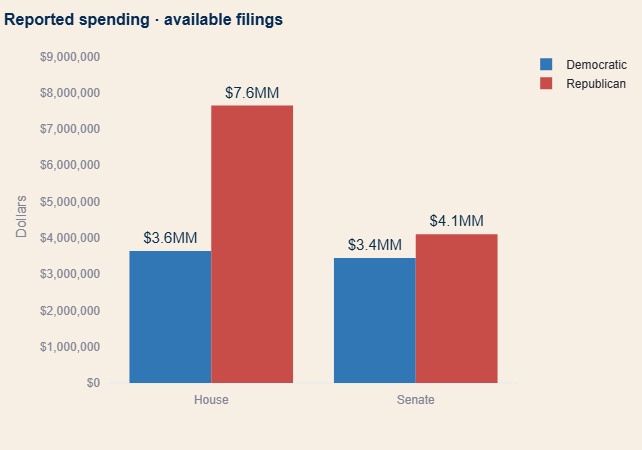
One interesting takeaway is that the Republican fundraising advantage is considerably larger than their spending advantage. Republicans have raised roughly twice as much money as Democrats but have spent only about 67% more.
Of course, these figures only tell part of the story. They reflect money flowing through the candidates’ campaigns, not necessarily the full extent of spending by political parties, PACs, and outside groups that can influence these races.
It will be particularly interesting to see how these numbers change once the third-quarter reports are available. Money certainly isn’t everything in politics, but it can make a meaningful difference in a competitive race—and North Carolina has several of those this cycle.
A Closer Look at Gaston County
Bringing things closer to home, here’s how the General Assembly races in Gaston County stack up financially (click on the graphic for individual races).
Gaston County Races


You can also explore the fundraising and spending figures for any other North Carolina General Assembly race using my Carolina Money Trail app.